Welcome to LeBonTag
LeBonTag helps an organisation use OpenStreetMap (OSM) as a local reference dataset. Users review incoming changes, check data quality, export changes and follow activity on their territory.
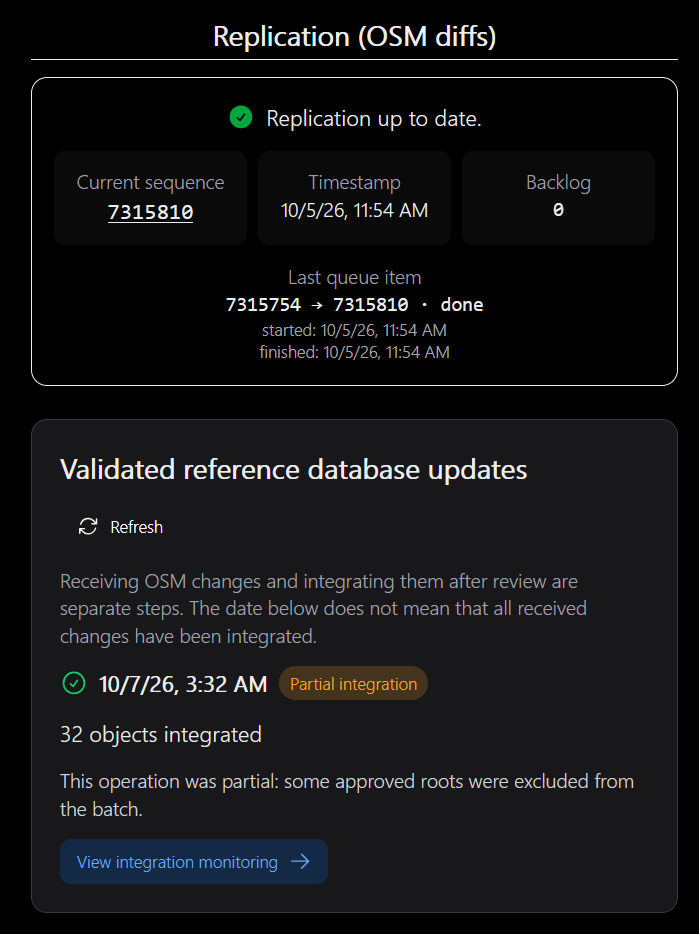
Accepting a change in LeBonTag does not edit OpenStreetMap. Approved data is integrated into the organisation's local database by a separate service. Optional segmentation then builds a derived network of road sections.
Choose your starting point
| Your goal | Guide |
|---|---|
| Start a working session | My territory |
| Navigate, select objects and change map backgrounds | Maps |
| Review OSM changes, alone or with other teams | Validation |
| Examine quality findings | Quality |
| Download changes or follow activity | Export · Statistics |
| Personalise the application and subscribe to emails | Account · Notifications |
| Configure the organisation | Administration |
| Understand how data reaches the local reference | Architecture · Integration |
| Install or upgrade | Native installation · Docker · Upgrade |
| Resetting OSM Data (reboot) | Reboot |
Three different notions of freshness
- Replication: how far the download and ingestion of OSM changes have progressed.
- Integration: which approved changes have actually reached the local reference database.
- Segmentation: which reference state was used to build the derived road sections.
A recent replication timestamp does not mean every change has been approved or integrated. See About for freshness information and the administration monitoring page for detailed outcomes.
Vocabulary
- Territory / footprint: a geographical area assigned to a user.
- Business group: a team with shared review responsibilities.
- Object group: a thematic selection of OSM objects defined by a rule.
- Root: an approved object version selected for an integration batch.
- Dependency: a node, way or relation needed to reproduce another object correctly.
An OSM identity always includes its type: node/42, way/42 and relation/42 are different objects. A reviewed change also has a version, such as way/42/7.